Coen Brothers O Brother Where Art Thou Interview Odyssey
A sking somebody to name their favourite Coen brothers film is similar pondering which Australian political political party is the most reprehensible – a conversational rabbit hole, with no possible hazard of consensus. Quality-wise we are spoiled for choice, with so many nuggets of gilt to pan from the Coen reserve. Is it the Hitchcockian cantankerous-country thriller No Country for Former Men, the micturated-upon-on-my-rug stoner classic The Big Lebowski or is it the icy blackness one-act crime caper Fargo? Yah? Oh yah.
But in my listen the greatest Coen brothers moving-picture show is the semi-musical, semi-satirical, semi-historical, semi-mythological and completely brilliant comedy O Brother, Where Fine art Thou?, which turns 20 this year. Its narrative world exists very far from anywhere with the internet and memes, yet this absurdly entertaining and witty film is so damn memeable, loaded with snackable dialogue fans will instantly recognise.
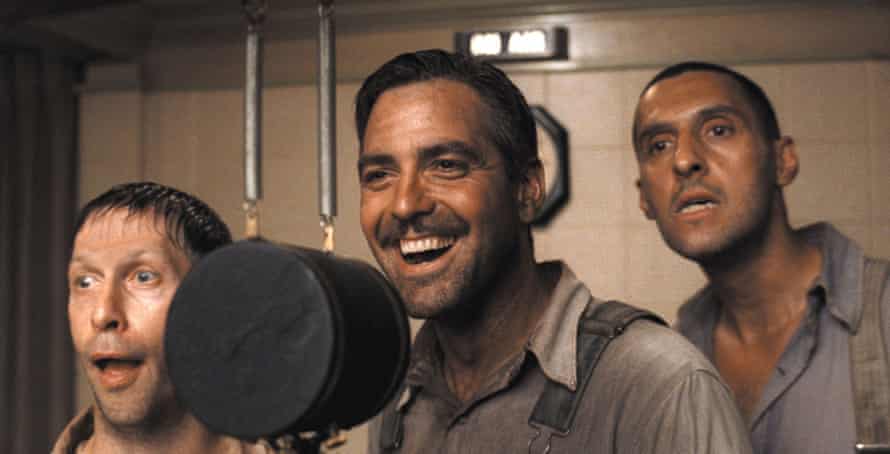
Based in the corn fields, concert halls and on the open roads of rural Mississippi during the Great Depression, it is a ye olde adventure sprinkled with delectably passé American turns of phrase such as "damn his optics!" and "what in the Sam Hill?" A loose adaptation of Homer'southward The Odyssey, the film recasts the story of Odysseus'south try to return to his dwelling house island of Ithaca every bit a tale of three convicts, initially chained together, journey to discover a treasure that doesn't exist. Everett (George Clooney) is using the hope of riches to trick the two men he is chained to, Pete (John Turturro) and Delmar (Tim Blake Nelson), into helping him locate his estranged married woman.
Pete and Delmar aren't exactly the sharpest tools in the shed, their nincompoopery a source of constant entertainment when contrasted against Everett's great intellect, absurd silver natural language and self-appointed condition as the grouping's loftier-muck-a-muck.

After the trio bump into a bullheaded soothsayer who accurately predicts that the journey ahead of them will involve "a road fraught with peril" and an come across with "a cow on the roof of a cotton house", they embark on a kind of vignette-filled tour of folkloric America. The Coens insert historical figures such equally Tommy Johnson (a black bluesman who claimed he sold his soul to the devil) and George "Infant Face" Nelson (a diminutive banking concern robber who partnered with John Dillinger), equally well every bit fictitious figures reflective of dark aspects of the American psyche – including John Goodman's violent, thieving bible salesman, and a popular politician (Wayne Duvall) who is a fellow member of the Ku Klux Klan.
The picture entangles history with mythology and spills over into magical realism. Music is used extensively, the era-specific and dazzlingly eclectic soundtrack selling over seven million copies in the U.s. alone, awakening America – in the words of this Guardian article – "to a musical heritage it had forgotten it owned". When Everett and co's band, chosen The Soggy Bottom Boys, go to the radio shack or take to the phase to sing songs like Human of Abiding Sorrow the film becomes, oh my lord, how to describe it? Eardrum candy? Yah, that'll do: eardrum candy. The O Blood brother soundtrack awoke many of united states of america to a musical heritage we never even knew nosotros liked.
During an age in which the very concept of originality ofttimes seems like a dusty relic from a distant era, O Brother, Where Are G? stands autonomously in its uniqueness; I defy anybody to name a movie like it. I beloved the film for the same reason Jacques Tati'southward Playtime is my favourite characteristic of all time: information technology trades in a kind of filmmaking that never really existed. For Tati information technology was about infinite and architecture. But O Brother's singularity is harder to define – a combination of songs, history, mythology and comedy, mixing literature and theatricality with the language of music videos.
An absurdist fourth dimension sheathing of a period that sort of existed and sort of didn't, the film's intellectualism is inseparable from its willing cover of nonsense, farther muddying the waters in the already unclear debate about what constitutes "high" versus "depression" fine art. Here the Coens show a clever synergy with the picture show from which the title originates: the writer/managing director Preston Sturges' brilliant 1941 film Sullivan's Travels, almost a snobby film director who wants to brand a highfalutin social realist drama (called O Brother, Where Art Thou??) before eventually embracing the value of silly escapism.
And so much to beloved; so much to revere. And yet trying to make sense of O Brother, Where Art Thousand? comes part-and-parcel with the sensation that one is being deliberately led downward the garden path. Mayhap, every bit Everett himself puts it: "It'southward a fool who looks for logic in the chambers of the human heart."
hendersonconifice.blogspot.com
Source: https://www.theguardian.com/culture/2020/jun/19/o-brother-where-art-thou-revisiting-the-glory-and-silliness-of-the-coen-brothers-classic
0 Response to "Coen Brothers O Brother Where Art Thou Interview Odyssey"
Post a Comment